
Energy flexibility: transform your assets into drivers of growth
Energy flexibility refers to a company’s ability to adjust its electricity consumption, generation, and storage in response to power system constraints and market conditions.
For industrial and commercial sites, it serves as a strategic driver for controlling energy costs, securing the energy supply, strengthening energy resilience, and accelerating decarbonization. It also makes it possible to leverage the adaptability of assets, particularly through arbitrage on electricity markets and participation in certain mechanisms that contribute to grid stability.
In a context of price volatility and growing constraints on power networks, flexibility makes it possible to adapt the operation of energy equipment and assets to the site’s needs, market conditions, and the requirements of the power system. It thus helps improve the company’s energy and economic performance, while contributing to network balance.
It’s a practical way to optimize energy bills, reduce your carbon footprint, and strengthen energy resilience. GreenYellow supports businesses with customized, fully-financed, and long-term solutions to unlock this flexibility potential without tying up capital (€0 CAPEX).
In this article, find out what energy flexibility is, its role in the electricity system, and the drivers available to your business.
- Energy flexibility enables companies to adjust electricity consumption, generation and storage in order to reduce energy costs and limit exposure to price spikes.
- Energy flexibility relies on operational levers such as demand-side management, local energy generation and energy storage to optimize site operations.
- Energy flexibility enhances the value of existing energy assets and can generate additional revenue streams through available flexibility and market participation mechanisms.
- Energy flexibility supports corporate decarbonization efforts by shifting electricity consumption to periods when the power mix is less carbon-intensive and more heavily supplied by renewable energy sources.
What is energy flexibility?
Energy flexibility refers to the ability to adjust a site’s electricity consumption, generation, or storage on short notice in response to network needs and market conditions. It helps maintain the balance between electricity supply and demand without systematically relying on new generation capacity. In practice, it relies on the management of energy use: a company becomes flexible when it can adapt its consumption profile or mobilize its energy assets in response to an external signal, such as a change in electricity prices or a network request.
This adaptation can be based, in particular, on:
- Shifting certain energy uses to less expensive periods;
- Adjusting energy-intensive equipment;
- Activating generation or energy storage assets.
These mechanisms directly affect industrial and service-sector companies. A site can, for example, defer non-critical consumption outside of peak periods or activate local generation when conditions are favorable. At the level of a multi-site group, these adjustments can be coordinated and leveraged, with a measurable impact on energy costs.
For businesses, energy flexibility represents both an operational and financial challenge. It enables companies to manage consumption in order to reduce energy bills and improve operational performance.
Looking to unlock the potential of energy flexibility for your business?
Our experts support you every step of the way, from opportunity assessment to project financing.
What are the drivers of energy flexibility for industrial and commercial sites?
Flexibility relies on several drivers that can be implemented based on the company’s consumption profile and available energy assets. It is part of an approach to active electricity management that is integrated with the sites’ operational constraints.
Flexibility in energy consumption
Consumption flexibility relies on adjusting usage patterns, either by shifting certain consumption activities or by temporarily reducing non-essential loads. For example, a factory can recharge its electric carts during off-peak hours to reduce its energy costs. This approach helps limit businesses’ exposure to price spikes and network overloads.
Flexibility in energy production
A site with on-site generation, such as a solar carport installation, can adjust its usage based on network and market conditions. The electricity generated can thus be consumed on-site through solar self-consumption, with a view to maximizing economic efficiency.
Valuation of storage on electricity markets: energy arbitrage and potential revenues.
Beyond self-consumption and reducing power peaks, batteries (BESS) can generate additional revenue through energy arbitrage: storing electricity when prices are low, then discharging it or selling it when market conditions are more favorable.
Depending on the system’s characteristics and the available mechanisms, storage can also be leveraged by making its capacity available to the power network. The challenge is to optimize these various sources of value based on market opportunities and the site’s needs.
The role of storage in maintaining the balance of the electric power system: system services and network balancing.
Thanks to their responsiveness, batteries can help balance the power grid by participating in frequency regulation services and certain balancing mechanisms. They can thus help maintain the frequency around 50 Hz and respond to fluctuations in electricity generation and consumption.
These services help, in particular, to facilitate the integration of renewable energy and can provide additional revenue to companies, provided they meet the required technical and contractual conditions. Appropriate management allows this revenue stream to be reconciled with the site’s energy needs and operational constraints.
Flexibility through energy storage
Energy storage remains a driver that many industrial and service sector sites have yet to fully utilize.
It allows for the decoupling of production and consumption: electricity can be stored when it is available or cost-effective, and then used when the site’s needs or market conditions allow. Beyond controlling energy costs, this flexibility opens up opportunities to generate revenue on electricity markets and contribute to the stability of the power grid.
Aggregated flexibility (multi-site)
For multi-site organizations, pooling flexibility capacity enables the coordinated management of energy assets and facilitates their participation in electricity markets.
The various energy flexibility levers can be combined and managed in a coordinated way. Their activation depends on the specific constraints of each site and prevailing market conditions.
GreenYellow supports businesses and public-sector organizations in identifying and unlocking these flexibility opportunities. Our solutions are tailored to each client’s needs, delivered with no upfront capital investment (CAPEX) and managed over the long term through measurable performance commitments.
Energy flexibility: What are the benefits for your business?
From industrial sites to businesses in the retail and service sectors, companies face specific energy constraints that impact their performance and competitiveness. Cold, thermal production, lighting, air conditioning, and continuous processes account for a significant portion of electricity consumption.
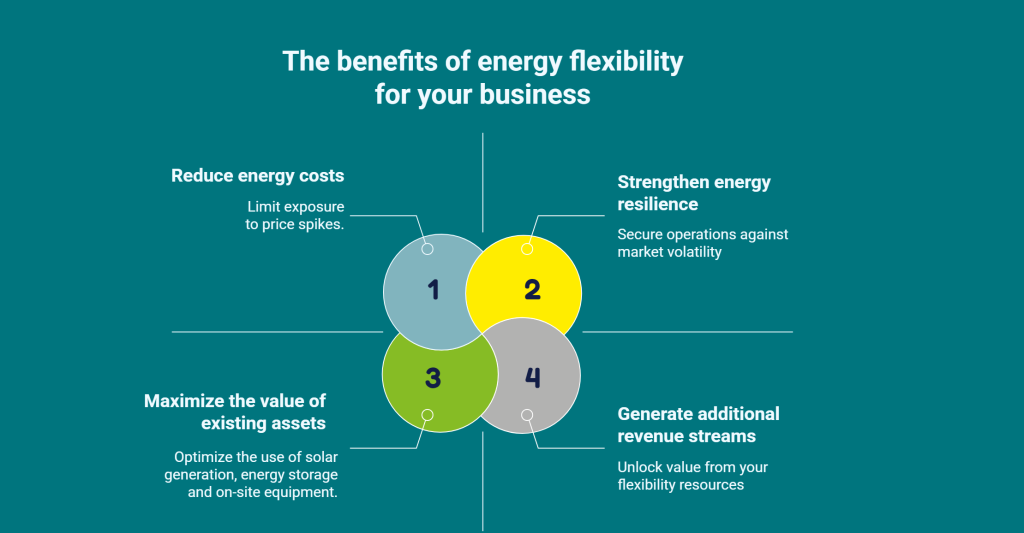
Energy flexibility makes it possible to transform these constraints into drivers of value creation and a competitive advantage. Here are four key benefits that result from this:
- Reduced energy costs: by shifting consumption to the most favorable periods, your company limits its exposure to price spikes and gains greater control over its energy bill.
- Enhanced energy resilience: energy flexibility enables your company to better manage energy risk. In an uncertain energy environment, controlling consumption helps ensure business continuity. The company gains long-term stability and predictability, while limiting the impact of market fluctuations on critical uses.
- Optimization of available assets: flexibility also improves the performance of existing energy assets. Local renewable energy production, storage systems, or energy-intensive equipment can be managed more precisely. Each kWh is used at the most appropriate time, which increases overall profitability.
- Monetization and revenue streams: Flexibility capabilities can generate additional revenue, particularly through arbitrage on electricity markets and participation in system services. These opportunities depend on the characteristics of the assets, the available mechanisms, and market conditions.
How does energy flexibility contribute to your company’s decarbonization efforts?
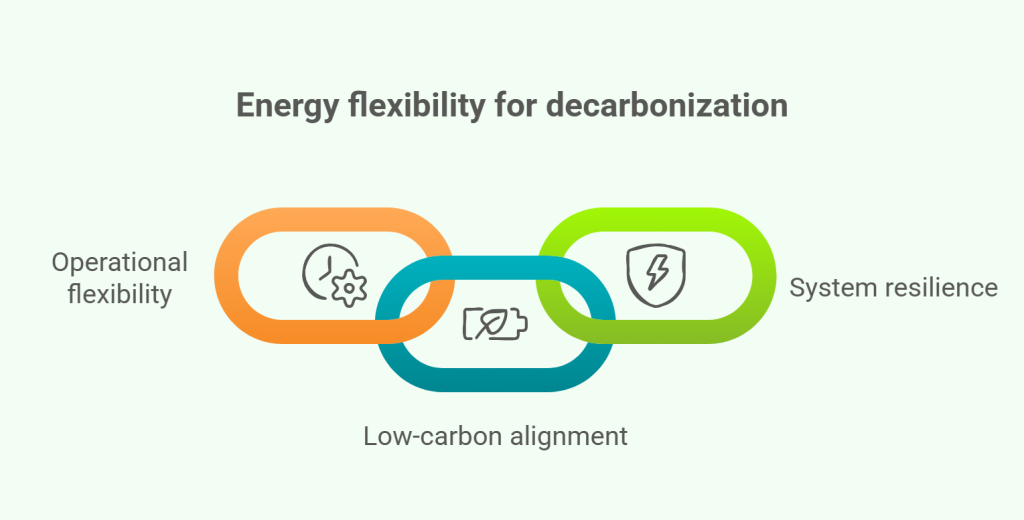
Against the backdrop of increasing electrification of industrial and service sector applications, the carbon impact of electricity varies depending on production conditions. When the power grid relies more heavily on carbon-intensive generation sources to meet demand, emissions associated with electricity consumption increase. In contrast, shifting demand to periods when electricity is generated with lower carbon emissions helps reduce those emissions. In this sense, energy flexibility contributes to the decarbonization of businesses by enabling them to adapt their electricity consumption to times when the power system is the least carbon-intensive.
In practical terms, flexibility relies on managing energy use to shift it to periods when electricity is more abundant from renewable sources (solar, wind, etc.) or is generally less carbon-intensive. It also helps avoid periods of high demand on the power grid, during which the system relies on more polluting generation sources.
These mechanisms complement other decarbonization drivers, such as energy efficiency or investment in equipment with lower emissions or lower energy consumption. Opting for energy flexibility enables manufacturers and multi-site companies to optimize their operations in real time or near real time.
Thus, energy flexibility serves as a leverage for operational adjustment. It allows companies to better align their electricity consumption with the availability of low-carbon electricity, thereby reducing their carbon footprint while strengthening the resilience of the electric power system.
How can you incorporate energy flexibility into your business?
The implementation of energy flexibility is based on a step-by-step approach focused on understanding energy usage and the energy operations of facilities. It begins with identifying the highest-consumption areas and controllable uses that do not impact operations, such as Cold, some thermal processes, or building management systems. This step helps determine the available adjustment margins.
Once these drivers have been identified, the next step is to structure the various components of the energy system. Optimizing energy consumption, local generation, and energy storage help enhance the site’s agility. Appropriate control mechanisms then allow for adjusting energy usage based on electricity prices, grid constraints, or opportunities for revenue generation.
Over time, these capabilities are coordinated and gradually activated, either at the site level or across a multi-site portfolio. Through partner operators such as GreenYellow, this approach improves energy performance by leveraging existing assets and modernizing them, without requiring any initial investment from corporate clients.
Why does the energy landscape reinforce this need for flexibility?
The transformation of the electric power system is increasing the need for energy flexibility. The rise in renewable generation, the gradual electrification of end uses, and changing consumption patterns require more dynamic management of the balance between generation and demand.
In its forward-looking study Energy Futures 2050, RTE (the operator of the electricity transmission grid in France) emphasizes the importance of flexibility, demand response, storage, and balancing resources to support the evolution of the electricity mix and ensure security of supply.
ADEME (the French agency for ecological transition) also identifies flexibility and storage as essential drivers for adapting the electricity system to new energy challenges. For businesses, this represents an opportunity to better manage their consumption, maximize the value of their energy assets, and integrate more renewable energy.
In a context where electricity prices remain subject to market fluctuations, flexibility also becomes an economic driver. It allows businesses to reduce their exposure to periods of high prices by adapting their electricity usage to grid and market conditions.
Looking to unlock the potential of energy flexibility for your business?
Our experts support you every step of the way, from opportunity assessment to project financing.
Frequently asked questions about energy flexibility for C&I businesses
What is energy flexibility?
Energy flexibility refers to a company’s ability to adjust its electricity consumption, generation, or storage based on grid needs, market conditions, or the availability of renewable energy. It helps optimize energy costs, strengthen the resilience of facilities, and contribute to the decarbonization of operations.
Why should a company become energetically flexible?
Becoming flexible enables a company to better manage its electricity consumption and adapt to changes in the energy system. This approach helps reduce exposure to price spikes, improve the performance of energy assets, secure the energy supply, and enhance the competitiveness of industrial and commercial sites. It can also make it possible to monetize certain balancing capacities within the power system.
What are the key drivers for developing energy flexibility?
Energy flexibility can rely on various equipment and technologies capable of adapting electricity usage. Among the main drivers are:
- Energy storage systems,
- Photovoltaic systems for self-consumption,
- Energy management systems (EMS),
- Controllable electrical equipment such as certain cooling, heating, power generation, or charging systems.
These solutions make it possible to adjust consumption based on the site’s needs and grid signals.
Can energy flexibility help lower your electricity bill?
Yes, energy flexibility can help reduce electricity bills by allowing certain energy consumption to be shifted to times when electricity is less expensive, limiting power demand during peak periods, and optimizing the use of available energy assets. Depending on the site’s profile and the mechanisms available, it can also generate additional revenue by monetizing flexibility capabilities.
Does a company need to invest to become flexible?
Not necessarily. Implementing an energy flexibility strategy can build on existing equipment and be supplemented by new solutions tailored to the site’s needs.
With support such as that offered by GreenYellow through its Energy-as-a-Service model, companies can identify their flexibility potential, deploy tailored solutions, and benefit from appropriate financing, without requiring any initial CAPEX, while managing energy performance over the long term.
How can a battery generate revenue in the electricity markets?
A storage battery (BESS) can generate revenue through energy arbitrage by storing electricity when prices are low and discharging or selling it when market conditions are more favorable. It can also capitalize on its flexibility by participating in certain market mechanisms. Revenue depends on electricity prices, the storage battery’s characteristics, and available opportunities.
How can a storage battery benefit the power system?
A storage battery can contribute to the stability of the power system by participating in frequency regulation services and certain balancing mechanisms. Thanks to its responsiveness, it can help maintain the grid frequency at around 50 Hz and respond to fluctuations in generation and consumption. Provided that the necessary technical and contractual requirements are met, these services can also represent a source of additional revenue for the company.

