Smart Grids : Intelligent electricity grid – Full deciphering
In the face of the energy transition and the challenges of sobriety and resilience, Smart Grids are emerging as an essential solution. At the crossroads of electricity and digital technology, they are redefining the way we produce, distribute and consume energy. This article provides an educational overview of how they work and their benefits.
What is a Smart Grid?
Definition
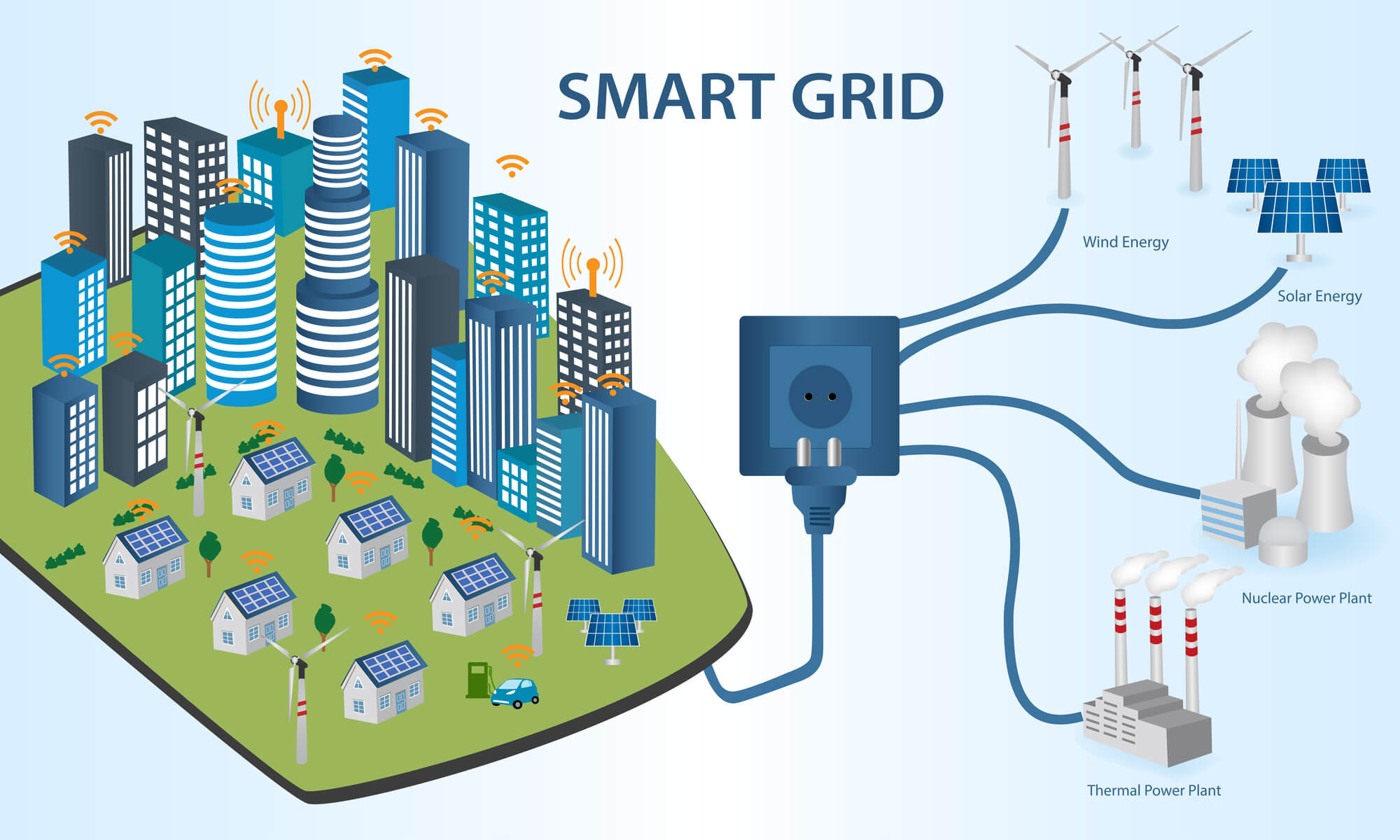
The term Smart Grid refers to an intelligent electrical network capable of integrating information and communication technologies to efficiently manage energy flows. Unlike traditional grids, where electricity flows unidirectionally from producer to consumer, a Smart Grid favors bidirectional exchanges, where the consumer himself becomes a player in the grid – a “prosumer” – capable of producing and consuming his own energy.
These networks are based on the use of intelligent sensors, control algorithms and a digital communication system. They enable electricity distribution to be adapted in real time according to consumption, local production and climatic conditions.
A changing context
La transition énergétique mondiale impose une refonte des infrastructures traditionnelles. Consumption peaks, the development of intermittent energies such as solar and wind power, and regulatory pressure to reduce CO₂ emissions are driving public and private players to rethink grid management…
Smart Grids are part of this logic, offering a technological response to the challenges of balance, flexibility and resilience of the power system.
The main features of a Smart Grid
Smart grids are characterized by several key features:
-
Flexibility: they adapt to the variability of renewable energies such as solar and wind power.
-
Reliability: they anticipate breakdowns and manage incidents more effectively.
-
Accessibility: they facilitate the integration of new players (prosumers, charging stations, etc.).
-
Savings: they optimize network operation and reduce energy losses.
Network architecture
A Smart Grid is based on a modular, interconnected architecture combining :
-
Smart meters installed on consumers’ premises,
-
Decentralized production units (solar panels, batteries),
-
A layer of information technologies (AI, Big Data, IoT),
-
A centralized supervision system capable of processing huge volumes of data.
How does a smart grid work?
Profitable, sustainable projects
A smart grid is a production → distribution → consumption chain, made dynamic by real-time data collection and analysis. The information emitted by sensors enables :
-
Adjust production to demand (and vice versa),
-
Prioritize the use of renewable energies,
-
Reduce consumption peaks,
-
Detect anomalies.
Imagine an industrial site equipped with a solar power plant and batteries. During the day, the sensors detect low consumption on site: the electricity produced is therefore stored. At the end of the day, when demand rises, the stored energy is used in priority, avoiding recourse to the more costly public grid.
Intelligent control also enables surplus energy to be sold when market prices are favourable. For example, if a solar power plant overproduces at midday, the system can store the electricity or redirect its use to charging stations for electric vehicles.
What are the advantages of Smart Grids?
The benefits are many:
Economic benefits
-
Reduced network operating costs,
-
Optimizing the supply/demand balance,
-
Integration of self-consumption and decentralized storage.
Environmental benefits
-
Facilitating the integration of renewable energies,
-
Reduced energy losses,
-
Contributing to the carbon neutrality of territories.
Easy to implement and manage
Smart Grid projects today benefit from a mature technological ecosystem, where digital infrastructures, smart sensors, energy management platforms and storage solutions are now field-proven. This development has been accompanied by the development of specialized players capable of designing, financing, installing and maintaining these smart grids with a view to sustainable performance.
Companies are no longer left to face technological complexity alone: they can call on experienced energy partners, capable of offering turnkey solutions including custom design, equipment integration, commissioning and operational monitoring. What’s more, the use of innovative contractual models, such as energy performance contracts (EPC) or third-party investment, makes it possible to align economic and environmental interests. In this type of contract, the supplier commits to measurable results (reduced consumption, lower emissions, etc.), which secures the end customer’s investment.
In this way, the gradual deployment of Smart Grids relies not only on technology, but also on the quality of support and control of financial levers to make them a real lever for energy transformation.
Real-life use cases in companies and local authorities
Today, Smart Grids are finding very practical applications in industry, the service sector and local authorities alike. For example, a business park can share its photovoltaic production between several buildings, enabling intelligent collective self-consumption. In a local authority, a Smart Grid can prioritize the supply of critical equipment (public lighting, hospitals, schools) in the event of overload or failure on the main grid. In commercial buildings, energy management systems enable consumption to be optimized according to occupancy, weather conditions or schedules, via pre-programmed scenarios. This is known as automated “demand response”. This kind of logic not only helps reduce energy bills, but also makes it possible to integrate virtuous practices that can be taken into account in CSR initiatives or carbon audits. As technologies become more widely available, Smart Grids are becoming accessible to an ever wider range of players, including SMEs and public institutions. It’s a silent but profound revolution in our relationship with energy, placing intelligence at the heart of the network.
Source : Enedis – Smart Grids, the new intelligence of the grid
What are the limits of Smart Grids?
| Limit | Explanation |
|---|---|
| Initial investment | Upgrading networks and installing sensors requires substantial funding. |
| Cybersecurity | Continuous data transmission opens up the risk of hacking or information leaks. |
| Management complexity | Real-time analysis and cross-referencing of data require a high level of technical expertise. |
| Interoperability | Integration between equipment from different suppliers can pose compatibility problems. |
Why opt for a smart grid?
Smart Grids meet several strategic needs:
-
Real-time monitoring: better visibility of energy flows,
-
Reduced downtime: thanks to early detection of anomalies,
-
Energy independence: by facilitating self-consumption and local resilience.
They also enable active demand management, encouraging users to adapt their consumption to the network context.
Smart Grid implementation
To make the most of the benefits to which Smart Grids give access, it’s important to be accompanied by a partner, a company with expertise in this field.
Turnkey solutions
GreenYellow, a recognized expert in energy transition, offers turnkey solutions to help companies integrate these smart grids.
Our expertise combines :
-
Energy management and smart metering
-
Innovative financing models (third-party investment, CaaS, etc.)
We have also forged a strategic partnership with Schneider Electric to accelerate the intelligent electrification of large companies:
👉 Read the article
Conclusion
The Smart Grid is more than just an innovation: it’s a structural revolution in the way we produce, distribute and consume energy. For businesses and local authorities, it represents a strategic lever for reducing their carbon footprint, improving their energy efficiency and ensuring their autonomy.
At GreenYellow, we don’t just deploy technologies. We support our customers from A to Z and over the long term: feasibility studies, tender management, financing, installation, maintenance and performance analysis.
📩 Want to know more? Contact our GreenYellow experts now to activate your energy transition.
Discover our Client references