
Public Sector
The Public Sector, which encompasses all administrations, hospitals, schools, universities, and public infrastructures, is characterized by functional diversity and a strong requirement for service continuity. Public buildings and the services they host are significant energy consumers, while also needing to comply with strict budgetary and regulatory constraints.
Greenhouse gas emissions in the public sector mainly come from heating, air conditioning, lighting, and IT usage, as well as from hot water production and the operation of technical equipment. The need to ensure comfort, safety, and service availability implies continuous and hardly compressible energy consumption.
In a market context marked by energy price volatility, pressure on public budgets, and tightening environmental regulations, energy modernization represents a strategic lever to improve the efficiency of public infrastructures while reducing their carbon footprint. The transition is no longer limited to reducing consumption: it now relies on a set of complementary levers integrating energy efficiency, electrification of uses, on-site renewable energy, and the development of energy flexibility through energy storage.
GreenYellow supports public sector stakeholders with a global and integrated approach covering the entire energy value chain — from needs assessment and analysis to the management of deployed solutions, including design, financing, and implementation. This approach reconciles economic performance, operational security, and reduction of environmental impact.
Improving energy efficiency and electrifying uses
Public buildings and infrastructures present significant potential for energy optimization, particularly due to repetitive usage patterns and standardized technical installations. Improving energy efficiency is a key lever to sustainably reduce consumption and costs.
This involves optimizing heating, ventilation, air conditioning, and lighting systems. Enhancing the performance of boilers and heat pumps, recovering heat from technical networks, optimizing distribution networks, and reducing losses in installations can generate significant savings while ensuring occupant comfort and safety.
Electrification of uses is also a structuring lever for the energy transition. It involves gradually replacing fossil fuels with decarbonized electrical solutions, such as heat pumps for heating and cooling or connected LED lighting. Combined with storage solutions, electrification smooths out energy consumption and ensures the continuity of public services.
Transition to local, green energy production
Public buildings and sites often have large roof areas and a stable consumption profile, which is advantageous for deploying local renewable energy.
Integrating self-consumption photovoltaic systems allows for locally produced decarbonized electricity, used directly for heating, lighting, cooling, or IT equipment. This local production helps sustainably reduce energy expenses and limit exposure to energy price volatility.
It also contributes to achieving carbon neutrality goals and enhancing the responsible image of public administrations to citizens. GreenYellow offers a turnkey model with no initial investment — 0€ CAPEX — with performance and availability guarantees, allowing public institutions to deploy these solutions simply, quickly, and safely.
Innovation | Energy demand management
Energy management in the public sector must consider strong constraints related to service continuity, occupant comfort, and equipment safety. Implemented solutions must therefore be reliable, secure, and non-intrusive.
Energy storage is an essential lever for improving site flexibility. Batteries help smooth consumption peaks, while thermal storage allows heating or cooling to be shifted according to needs and economic opportunities.
Additionally, advanced energy management solutions enable real-time synchronization of production, consumption, and renewable energy generation. This approach optimizes equipment operation without compromising comfort or service continuity. The development of Microgrids in partnership with Schneider Electric, fully aligns with this approach, offering intelligent, resilient local energy management.
Cost management and investment
Public institutions are particularly sensitive to budgetary constraints and investment priorities focused on public service. In this context, the energy transition can be perceived as a challenge if it requires significant upfront investments.
The ESCO model offered by GreenYellow removes these constraints by providing a fully financed solution, requiring no CAPEX from the client. Projects are studied, designed, financed, deployed, operated, and maintained by GreenYellow, with a contractual guarantee of energy performance.
This model allows administrations to immediately benefit from energy and financial savings while eliminating technical and financial risks. It accelerates energy modernization, making high-performance solutions accessible without complex budgetary trade-offs.
Regulatory compliance
The public sector operates within a strict regulatory framework, combining environmental obligations, energy performance standards, and safety requirements. GreenYellow supports clients locally to fully integrate these constraints into the design and deployment of energy solutions, ensuring regulatory compliance and high performance.
Awareness and Engagement
The success of the energy transition relies on the involvement of technical and administrative teams. Staff, technical managers, and leadership must be made aware of energy issues and supported in evolving practices.
Developing a culture of energy performance is essential, while ensuring service continuity and occupant comfort, which remain top priorities in the public sector.
Discover our achievements in the public sector

- Energy Efficiency

- Electric Mobility
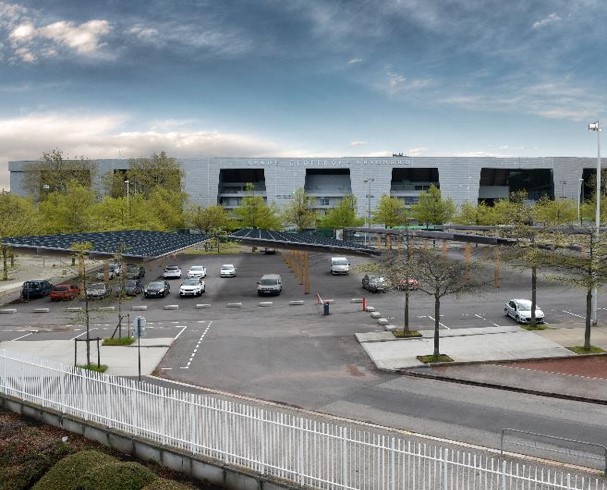
- Solar energy production
Let’s measure together the impact of your energy transition actionson your competitiveness and environmental footprint, and explore the levers to decarbonize, electrify, and flexibilize your energy usage

