
Overview of energy consumption in the industrial sector in 2026
In 2026, energy consumption in industry will be at the crossroads of several dynamics: sustained price volatility, tighter European regulations, the rise of renewable energies, and global competitive pressure.
To remain competitive, industrial companies must better understand how their energy use is changing, both in France and across the European Union.

2026: a pivotal year for industry energy consumption
- energy costs that remain unstable,
- stricter decarbonization targets,
- and new obligations arising from European energy policies.
Industrial energy consumption is thus becoming a key driver for competitiveness: reducing kWh consumption, smoothing out peaks, and securing prices over the long term are now strategic priorities.
Key figures on industrial energy consumption: France and Europe
Focus on France: where does French industry stand?
According to the Energy Balance Sheet for France and the Key Energy Figures published by the SDES, industry accounts for around 20% of the country’s final energy consumption.
Some key figures:
- French industry remains one of the country’s main energy consumers, behind transport and residential/tertiary sectors.
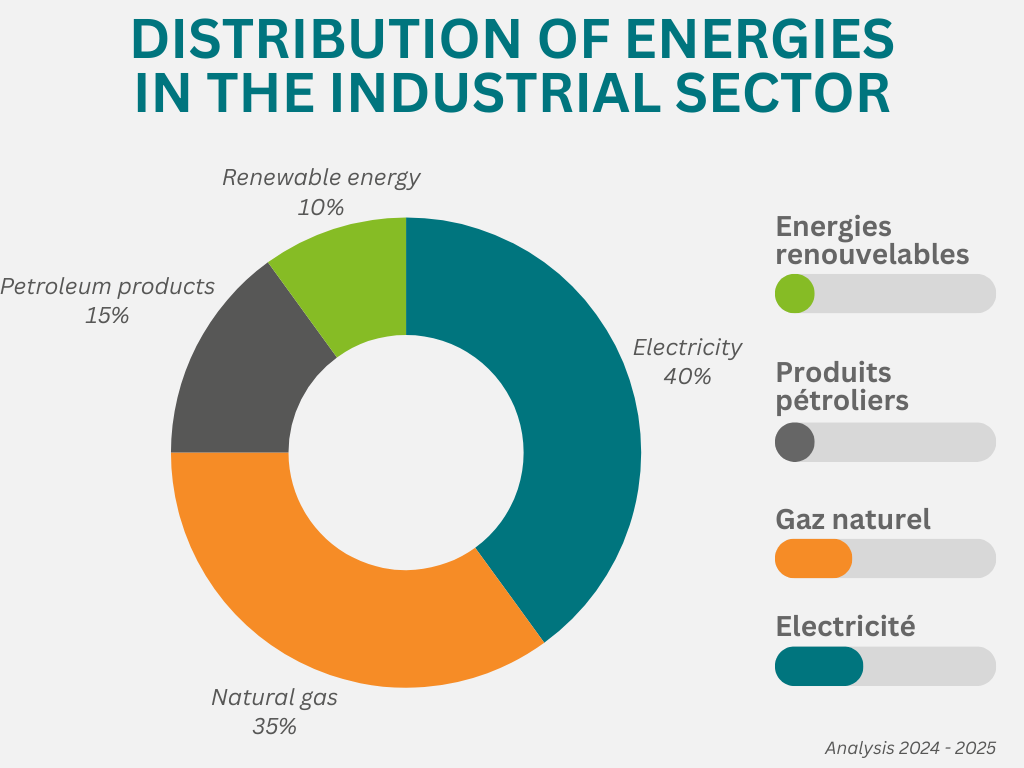
- The industrial energy mix is dominated by electricity and natural gas, which account for nearly 75% of usage (processes, heating, steam, cold, etc.).
- Between 2023 and 2024, industrial energy bills rose by around +14%, due to the combined effect of the economic recovery and price volatility.
=> To learn more about drivers for reducing your company’s energy bill, check out our article.
Data from INSEE confirms the energy weight of certain sectors: chemicals, metallurgy, agri-food, and construction materials account for most of the energy consumption in industry.
Industry at the heart of the European Union’s (EU) energy transition
At the European Union level, industry accounts for around a quarter of final energy consumption (Eurostat).
- a reduction of at least 11.7% in energy consumption compared to the 2020 trajectory,
- an increase in the share of renewable energy to at least 42.5% of the European energy mix,
- and stricter requirements for large companies in terms of energy audits and action plans.
France vs. Europe: what are the specific characteristics of industrial energy consumption?
- France benefits from a highly decarbonized electricity mix (nuclear + renewable energy – RE), which limits the carbon intensity of its industry compared to countries such as Germany, which is highly dependent on coal and gas.
- French manufacturers nevertheless remain exposed to the volatility of electricity and gas prices at the European level, as shown by INSEE price data and European Commission analyses.
- There is strong investment momentum in Solar photovoltaic energy for self-consumption in several countries (Spain, Italy, and Germany), a trend that is also observed among French manufacturers, as illustrated by the projects carried out with GreenYellow.
Industry’s energy mix: what changes will we see in 2026?
- Electricity: its share is gradually increasing in many processes (electrification of thermal uses, industrial heat pumps, etc.).
- Natural gas: remains central, but its consumption is tending to decline in decarbonization scenarios, in favor of more energy-efficient processes and renewable heat.
- Petroleum products: declining in certain uses, particularly for process heat, but still used at high temperatures.
- Renewable energies and heat recovery: on the rise, driven by national (France 2030) and European initiatives.
Industrial energy performance: real-world examples
- Forvia reduced energy consumption by 50% at two of its plants by conducting energy audits, optimizing energy contracts, and implementing energy efficiency solutions led by GreenYellow.
- Legrand has deployed photovoltaic power plants for self-consumption at seven industrial sites in France, helping to stabilize its energy bill while reducing its CO₂ emissions.
- reduce industry energy consumption,
- control costs,
- limit exposure to fluctuations in European energy markets.
What strategies can be used to improve energy efficiency in 2026?
1. Optimize energy consumption in processes
The first step is to gain a detailed understanding of the plant’s energy consumption: mapping usage, identifying deviations, and analyzing load profiles.
- modernization of equipment (motors, drives, compressors, and burners),
- precise process control (temperature, pressure, and flow rates),
- reduction of “hidden” consumption (compressed air, cold, standby, leaks, etc.),
- implementation of energy performance indicators (kWh/unit produced).
2. 2. Develop solar photovoltaic self-consumption
- local production, as close as possible to the needs of production lines,
- reduction in the volume of energy purchased from the grid,
- better long-term visibility on the cost of part of the energy,
- improvement in carbon footprint.
3. Integrate energy storage solutions
Energy storage is an additional driver for optimizing industry energy consumption:
- smoothing out power peaks,
- arbitrage entre heures pleines / heures creuses,
- greater integration of solar energy,
- network services (flexibility).
4. Green internal mobility and logistics flows
Electric mobility (forklifts, service fleets, utility vehicles, etc.) also represents a source of optimization for energy consumption at industrial sites in France and Europe:
- reduced dependence on fossil fuels,
- lower operating costs,
- enhancement of CSR commitments.
5. Structure a decarbonization strategy aligned with European objectives
European energy policies, which have become more ambitious since 2025, are redefining companies’ energy trajectories.
- a comprehensive view of emissions (Scopes 1, 2, and 3),
- a prioritized investment plan (energy efficiency, renewable energy, energy purchases, and mobility),
- the mobilization of support mechanisms (EEC, national aid, and European funds),
- and continuous monitoring of energy performance.
Summary: key points to remember for 2026
- Energy prices are expected to remain volatile, making it essential to control usage and diversify sources.
- European regulations impose clear targets for reducing consumption and developing renewable energies by 2030.
- Manufacturers who invest in energy efficiency, self-consumption, storage, and low-carbon mobility are gaining a head start in terms of both costs and environmental performance.
Want to know more? Find out about the energy challenges facing the industrial sector and the drivers for action.
Join more than 1,400 C&I clients in 15 countries who have already chosen energy independence with GreenYellow 👉 https://www.greenyellow.com/formulaire-de-contact/
Sources :
- SDES – Bilan énergétique de la France & Chiffres clés de l’énergie 2025 & Chiffres clés de l’énergie 2024
- INSEE – Consommation d’énergie dans l’industrie et prix de l’énergie
- RTE – Bilans électriques nationaux et régionaux &
- Eurostat – Indicateurs énergie & industrie
- Commission européenne – Objectifs climatiques 2030
- Directive (UE) 2023/1791
- Observatoire des territoires – consommation finale par secteur
- Banque des territoires – facture énergétique de l’industrie & part des ENR & https://www.banquedesterritoires.fr/energies-renouvelables-une-part-de-158-de-la-consommation-denergie-primaire-francaise-en-2024
- CITEPA
- France Stratégie – Intensité carbone France vs Allemagne,
- I4CE pour les analyses climat

