
Energy sobriety in business: from definition to solutions for lasting energy consumption reductions
What if controlling energy costs started before the bill even arrived?
Energy sobriety in business involves adjusting energy consumption to actual needs by addressing usage patterns and how activities are organized. For industrial and commercial businesses, it is a practical way to control costs and improve site performance.
In a context marked by volatile energy prices, decarbonization challenges, and the growing electrification of energy uses, energy sobriety goes beyond simple energy-saving habits. It relies on a better understanding of energy consumption, equipment suited to actual needs, and optimized operating conditions.
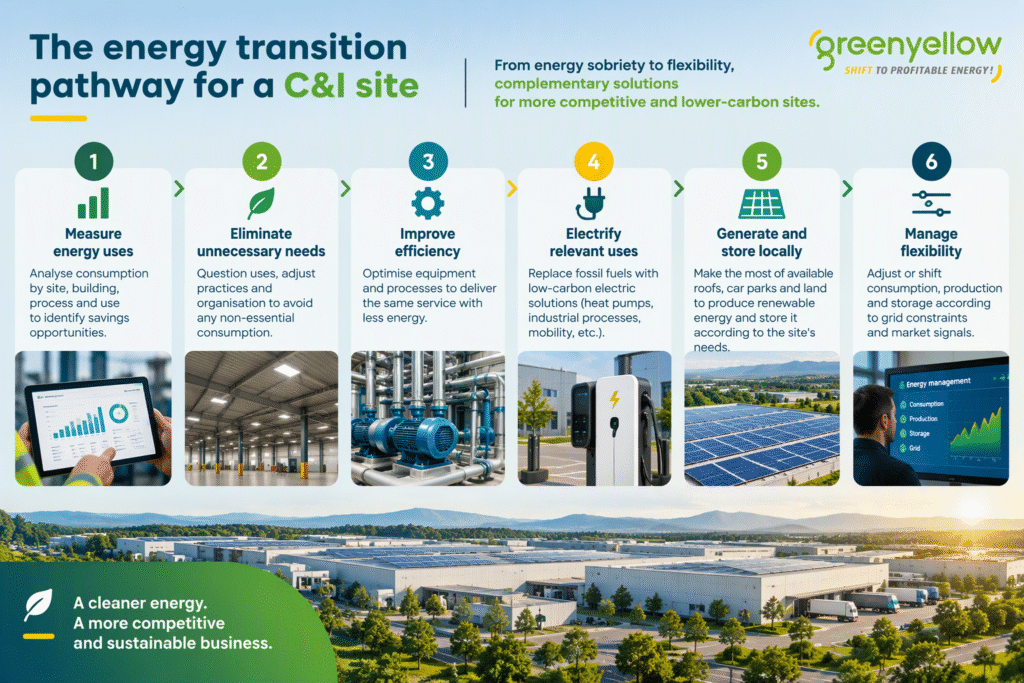
Combined with energy efficiency, the electrification of energy uses, and energy flexibility, energy sobriety helps build a coherent energy strategy.
The objective is to achieve lasting reductions in energy consumption and better manage power demand without compromising safety, quality, or operational continuity.
Key takeaways
- Energy sobriety involves reducing energy needs and consumption that are not necessary for business activities: production volumes, operating hours, target temperatures, lighting levels, mobility, or the amount of space used.
- Energy efficiency makes it possible to provide the same service with less energy through more efficient equipment and processes.
- Energy flexibility makes it possible to adjust or shift certain energy uses according to operational constraints and energy market opportunities.
- An effective energy sobriety plan relies on reliable data, prioritized actions, clearly defined responsibilities, and regular monitoring of results.
- For industrial and commercial sites, energy sobriety is a first step toward optimizing investments, preparing for electrification, and sustainably improving competitiveness.
What is energy sobriety?
Energy sobriety refers to an approach aimed at reducing energy demand by changing usage patterns, practices, and how activities are organized.
It seeks to avoid consumption that does not meet an essential need or a performance objective. This approach differs from one-off energy savings: it aims for lasting, measurable decisions that are compatible with business activities.
In practical terms, a business can reduce its energy consumption by adjusting lighting schedules to building occupancy, shutting down certain equipment outside production hours, adjusting temperature setpoints, or rethinking how its activities are organized.
In the approach promoted by institutions involved in the ecological transition, energy sobriety complements energy efficiency, electrification, and the use of low-carbon energy. The national plan introduced in 2022 was an immediate response to the risk of energy shortages and set a target of reducing energy consumption by 10% over two years compared with 2019.
In 2026, energy sobriety is part of a more structural long-term trajectory: PPE3 (Multiannual Energy Program of France), published on February 12, 2026, covers the 2026–2035 period and brings together energy sovereignty, carbon neutrality, and the maintenance of competitive energy prices. For a business, this direction must be translated into its own trajectory, developed based on its energy uses, seasonality, operational constraints, and investments.
What are the three types of energy sobriety?
- Usage-based sobriety: This involves adapting practices and equipment operating conditions to actual needs. It may involve reducing lighting hours, adjusting heating or cooling setpoints, limiting standby consumption, and switching off unused equipment.
- Dimensional sobriety: This involves sizing equipment, installations, and spaces as closely as possible to actual needs. For motors, refrigeration units, compressors, HVAC systems, or floor space, avoiding oversizing helps limit unnecessary energy consumption and associated losses while matching resources to the service actually required.
- Structural sobriety: This involves changing how activities, workflows, or spaces are organized to achieve lasting reductions in energy demand. This may involve sharing certain equipment, optimizing logistics flows, or changing organizational practices.
Identify priority energy uses, quantify energy-saving opportunities,
and develop a trajectory tailored to each site.
Energy sobriety, energy efficiency, and energy flexibility: what are the differences?
Energy sobriety, energy efficiency, and energy flexibility address three complementary questions: What need must be met, how can it be met with less energy, and when should energy be consumed?
Energy sobriety: addressing the need
Energy sobriety involves avoiding consumption that does not meet an actual need. It comes before technology choices by examining usage patterns, expected service levels, and operating conditions. For example, a business can adjust heating and cooling setpoints, align equipment operating hours with actual production needs, or limit heating or air conditioning in unoccupied spaces.The objective is to reduce or eliminate the need when it is unnecessary.
Energy efficiency: using less energy to deliver the same service
Energy efficiency aims to improve the performance of equipment and processes. It makes it possible to provide the same service with lower energy consumption. It relies in particular on optimizing heating and cooling systems, replacing energy-intensive equipment with more efficient solutions, installing variable-speed drives, and recovering waste heat to meet other site energy needs.
Learn more about energy efficiency in business.
Energy flexibility: consuming energy at the right time
Energy flexibility involves adjusting or shifting certain energy uses without compromising operations. It may apply to electric heating, refrigeration, pumping, vehicle charging, or certain industrial processes.
It helps manage peak power demand, adapt consumption to supply conditions and, depending on the configuration, take advantage of fluctuations in electricity prices. See our guide to energy flexibility in business.
Battery storage can complement this approach by shifting some of the available energy over time. Its suitability depends on the site’s consumption profile, power constraints, any local energy generation, and economic conditions.
These three levers are complementary. Energy sobriety avoids unnecessary needs, energy efficiency reduces the energy required to meet the remaining needs and improves equipment performance, and energy flexibility determines the most appropriate time to consume energy.
What is an energy sobriety plan?
At the national level, the energy sobriety plan launched in 2022 brought together the government, businesses, local authorities, and the French public more broadly around a rapid reduction in energy demand amid supply pressures. The reference roadmap is now PPE3 for 2026–2035, which places energy demand management within a broader strategy focused on sovereignty, competitiveness, and the decarbonization of the energy system.
At the business level, an energy sobriety plan takes the form of a roadmap tailored to the energy uses and operational constraints of each site. Starting from a baseline, it makes it possible to identify avoidable consumption, prioritize actions, set objectives and responsibilities, and then measure the savings achieved.
For industrial and commercial sites, implementation benefits from involving energy, maintenance, production, facilities, procurement, and finance teams to balance quick wins with structural investments. It should also be coordinated with energy efficiency, electrification, and flexibility projects, as well as the regulatory requirements that actually apply to each site.
Why has energy sobriety become a strategic issue for businesses?
Control costs and risks: Lower energy consumption reduces exposure to energy prices, while power management can limit peaks and certain grid costs. A breakdown of consumption by use also helps identify deviations before they result in additional costs.
Strengthen industrial competitiveness: In industry, energy is directly linked to production costs. Energy sobriety makes it possible to reduce consumption that does not contribute to the value produced and improve energy performance per unit produced. For retail, logistics, and commercial building operators, it also helps control the operating costs of buildings and equipment.
Decarbonize without compromising operations: Energy sobriety reduces the amount of energy that needs to be decarbonized. It also makes it easier to size electrical equipment, solar generation, storage, or energy supply contracts, for example, by avoiding excess capacity.
Prepare for the electrification of energy uses: Replacing certain thermal systems with electric solutions, such as heat pumps and electric furnaces, can change a site’s consumption profile and increase its electricity demand and power requirements. Reducing needs upfront, optimizing equipment, and exploring control opportunities make it possible to size installations more effectively and prepare for changes to the site’s energy system.
See the definition and implications of the electrification of energy uses.
Strengthen energy resilience: A site with detailed knowledge of its energy uses can establish priorities, shed noncritical loads, and maintain essential functions when constraints arise. This visibility improves energy independence and contributes to business continuity.
What are the main levers for energy sobriety in business?
1. Measure and analyze energy consumption by use
The first step is to establish a reliable baseline. Electricity and natural gas bills, along with main meters, provide an overall picture of consumption but are not sufficient to precisely identify energy-saving opportunities or guide decisions.
Submetering, remote meter reading, and an energy management system make it possible to analyze consumption by use: production, refrigeration, heating, ventilation and air conditioning (HVAC), compressed air, lighting, IT equipment, vehicle charging, or other equipment.
To use this data and track progress over time, it is also essential to account for factors that influence consumption, such as weather, production volumes, operating hours, occupancy rates, and operating conditions. This approach makes it possible to compare equivalent situations and identify the most relevant actions.
2. Optimize settings and schedules
Equipment settings and operating schedules are often a first opportunity to reduce energy consumption without changing the equipment. Reviewing operating hours, temperatures, pressures, flow rates, and startup sequences make it possible to identify optimization opportunities and achieve quick results.
In commercial buildings, warehouses, and retail stores, this means adapting heating, air conditioning, and lighting to actual occupancy.
In industry, the analysis focuses in particular on ensuring that auxiliary equipment is actually switched off outside production hours, detecting and repairing compressed-air leaks, optimizing startup sequences, and reducing the maintenance of operating temperatures when production is stopped.
These actions must be adapted to safety, quality, product preservation, and service continuity requirements.
3. Reduce hidden energy consumption
- Detecting and repairing compressed-air leaks;
- Reducing equipment energy consumption during periods of inactivity;
- Optimizing refrigeration, heating, and ventilation systems;
- Recovering waste heat to meet other site energy needs.
- Improving insulation and control systems;
- Installing high-efficiency motors, variable-speed drives, or advanced control systems;
- Replacing the least efficient equipment when appropriate.
4. Articuler solaire, stockage et flexibilité
Certains usages peuvent être décalés ou modulés pour réduire les pointes de consommation et adapter les appels de puissance aux contraintes du réseau, aux tarifs et aux besoins du site. Cette flexibilité peut concerner la recharge des véhicules, les équipements thermiques, le froid ou certains procédés industriels.
L’autoconsommation solaire couvre une partie des besoins en électricité, tandis que le stockage par batteries et le pilotage des charges permettent de décaler les consommations ou de valoriser certaines flexibilités.
Le dimensionnement de ces solutions doit s’appuyer sur les courbes de charge, les contraintes de raccordement, les marchés accessibles et la criticité des procédés.
5. Impliquer les équipes dans la durée
Energy sobriety does not rely solely on equipment. Everyday practices, operating instructions, and work organization also contribute to results.
To make the approach sustainable, it is useful to designate people responsible for each area or energy use, share clear objectives, and communicate results regularly.
Production, maintenance, operations, facilities, and energy teams should be involved to ensure that actions are compatible with on-site constraints.
Energy-saving habits are useful when they are part of a coherent organization and are supported by consumption monitoring. They do not replace technical analysis of installations or the necessary investments.
👉 To explore financial and operational actions further, also consult our guide to reducing your energy bill.
What is the european regulatory framework for energy sobriety in business?
Businesses must distinguish voluntary energy sobriety initiatives from regulatory obligations that may apply to their buildings, equipment, or activities.
Depending on their circumstances, they may be subject to requirements relating to the energy performance of commercial buildings, energy audits, energy management, or certain types of equipment and parking facilities.
At the European level, several legislative texts govern improvements in the energy performance of businesses and buildings. Their application depends in particular on energy consumption levels, building type, and national regulations.
The European Energy Efficiency Directive (EU) 2023/1791 strengthens requirements for energy audits and energy management systems for businesses exceeding certain consumption thresholds. The Energy Performance of Buildings Directive (EU) 2024/1275 provides, in particular, for measures to renovate commercial buildings and deploy solar solutions on certain buildings.
The Renewable Energy Directive (RED III) complements this framework by promoting the development of renewable energy.
These directives are transposed and implemented under national rules that may vary from one country to another. Businesses operating in several European countries must therefore verify the obligations applicable to each of their sites.
Beyond regulatory compliance, a structured approach to energy sobriety and energy performance makes it possible to better control consumption, prioritize investments, and support the decarbonization of activities.
Conclusion
Energy sobriety is neither a step backward for business activity nor a temporary campaign. It is a performance approach that puts needs at the center, supports sound investment decisions, and prepares businesses for electrification. For industrial and commercial sites, the most robust trajectory combines energy sobriety, efficiency, renewable energy generation, storage, and flexibility, supported by data-driven management.
GreenYellow supports commercial and industrial businesses from energy-use analysis through financing and deployment to the management of energy solutions.
FAQ – Frequently asked questions about energy sobriety
What is energy sobriety?
Energy sobriety in business involves systematically reducing energy demand by addressing usage patterns, practices, and how activities are organized. It aims to eliminate or reduce nonessential needs before improving equipment efficiency, without compromising quality, safety, or business continuity.
What are the main pillars of energy sobriety?
Three approaches are generally distinguished: usage-based sobriety, which adapts practices; dimensional sobriety, which adjusts equipment to actual needs; and structural sobriety, which transforms how activities, workflows, or spaces are organized.
What actions can reduce a business’s energy consumption?
The main actions involve measuring consumption by use, adjusting schedules and settings, eliminating unnecessary operation, optimizing equipment, and involving teams. Priority actions depend on the energy profile, business sector, and constraints of each site.
What is the difference between energy sobriety and energy efficiency?
Energy sobriety addresses needs and usage patterns to avoid unnecessary consumption. Energy efficiency makes it possible to provide the same service with less energy through more efficient equipment and processes. The two approaches complement each other.
Is energy sobriety compatible with increased production?
Yes. Energy sobriety does not necessarily mean reducing production or the service provided. It involves eliminating unnecessary consumption and better matching resources to needs. A business can therefore increase production while improving its energy performance per unit produced.
Is energy sobriety mandatory for businesses?
There is no single energy sobriety requirement that applies in the same way to all businesses. However, some organizations are subject to specific requirements relating to energy audits, energy management, building performance, or renewable energy generation. The situation depends in particular on the business activity, company size, and characteristics of its sites.
What is France’s aper law, and which businesses are affected?
The Law on Accelerating Renewable Energy Production (APER), dated March 10, 2023, aims to accelerate renewable energy development and provides, in particular, for requirements for businesses with certain buildings or outdoor parking facilities.
For outdoor parking lots larger than 1,500 m², it provides for a shading requirement covering at least 50% of the surface area, which, depending on the applicable provisions, can combine photovoltaic canopies covering at least 35% of the surface area with vegetated shading solutions for the remainder.
Thresholds, deadlines, implementation rules, and exemptions vary according to site characteristics and the regulations in force. Each business must therefore verify its obligations on a case-by-case basis.
Sources :
- Gouvernement français – Ce qu’il faut savoir sur le plan de sobriété énergétique
- Préfecture de l’Isère – Plan de sobriété énergétique
- Auvergne-Rhône-Alpes Énergie Environnement – Plans de sobriété énergétique : retours d’expériences
- Eco CO2 – Construire un plan de sobriété énergétique en entreprise
- Légifrance – Loi n° 2023-175 du 10 mars 2023 relative à l’accélération de la production d’énergies renouvelables

