
France’s Décret Tertiaire: Requirements, Targets and Key Deadlines
The Décret Tertiaire is a French regulation designed to progressively reduce final energy consumption in commercial and service-sector buildings in France. Also known through its implementation framework, Éco Énergie Tertiaire (EET), it applies to buildings and property portfolios that meet specific eligibility criteria under French law.
Under the relative-value method, the regulation sets energy consumption reduction targets of 40% by 2030, 50% by 2040 and 60% by 2050, compared with a reference year. An alternative compliance pathway allows regulated buildings to meet an absolute energy consumption target determined according to the activity carried out on site. Energy consumption and performance are monitored through OPERAT, the official reporting platform managed by ADEME, the French Agency for Ecological Transition.
As the first major 2030 deadline approaches, compliance with this French regulatory framework involves much more than annual reporting. Building owners, landlords, tenants and property managers operating buildings subject to the regulation in France need to ensure the reliability of their data, understand the energy trajectory of each building and plan the actions required to sustainably improve energy performance.
Key takeaways
- Who is affected? Owners and, depending on the situation, tenants of buildings, parts of buildings or groups of buildings used for commercial and service-sector activities with a combined floor area of at least 1,000 m² (10,764 sq. ft.), in accordance with the aggregation rules established by the scheme.
- What is the 2030 target? A 40% reduction in final energy consumption compared with the reference consumption level, or achievement of an absolute-value target corresponding to the relevant activity.
- What must be reported? Energy consumption must be reported annually on the OPERAT platform to monitor performance and compliance with the targets.
- Which drivers are included in the regulations? Improvements to the building envelope and equipment, operational optimization, energy management, changes in usage and, depending on the site, electrification and on-site energy generation.
- What are the penalties? The scheme provides for formal notices, publication of noncompliance and, in certain circumstances, an administrative fine of up to €1,500 for an individual and €7,500 for a legal entity.
What is France’s Décret Tertiaire?
France’s Décret Tertiaire was introduced by Decree No. 2019-771 of July 23, 2019, to implement Article 175 of the French the ELAN law. It sets out the requirements for reducing final energy consumption in buildings used for commercial and service-sector activities. It established the Éco Énergie Tertiaire scheme, which aims to put France’s commercial and service-sector building stock on a long-term trajectory toward lower energy consumption.
The Éco Énergie Tertiaire scheme establishes three major deadlines, expressed relative to a reference situation:
- 2030: -40%
- 2040: -50%
- 2050: -60%
These targets relate to final energy consumption. Compliance can be assessed using two alternative regulatory methods: the relative-value method (Crelat) and the absolute-value method (Cabs). The scheme also provides for adjustment and modulation mechanisms under the conditions defined by the applicable regulations.
This trajectory requires organizations to move beyond a purely administrative compliance approach and develop a genuine energy performance strategy combining energy measurement, operational optimization and investment.
Who is affected by the Décret Tertiaire in France?
The regulation applies to commercial and non-commercial service-sector activities in France. It covers, among others, offices, retail stores, hotels and restaurants, educational institutions, healthcare and social care facilities, sports and cultural facilities, warehouses, train stations, airports, parking facilities, laundries and data centers.
The requirements apply to owners and, where applicable, tenants of buildings, parts of buildings or groups of buildings used for commercial and service-sector activities with a combined floor area of at least 1,000 m² (10,764 sq. ft.).
The threshold may be assessed at the level of:
- A building used entirely for commercial and service-sector activities;
- The commercial and service-sector portions of a mixed-use building when their combined floor area reaches the threshold;
- A group of buildings located on the same land unit or site, subject to regulatory requirements.
An occupant using less than 1,000 m² may therefore still be affected if the premises it occupies form part of a building or real estate complex that falls within the scope of the regulation. The allocation of responsibilities between the owner and tenant depends, among other factors, on their respective responsibilities, the terms of the lease and the applicable rules, and should therefore be assessed on a case-by-case basis.
What are the exemptions?
The scheme provides for a limited number of exclusions, including certain structures built under a temporary building permit, buildings or parts of buildings used as places of worship, and certain operational activities relating to defense, civil security or internal security. The exact criteria are defined in the French Construction and Housing Code.
GreenYellow supports you in analyzing your energy consumption, identifying energy-saving opportunities and developing an energy roadmap tailored to your buildings and regulatory targets.
What are the targets of the Décret Tertiaire?
The regulations establish two methods for assessing whether energy consumption targets have been met: a relative value, Crelat, and an absolute value, Cabs. Determining the applicable method and ensuring data reliability are key steps in establishing a suitable trajectory for each building.
Relative-value target (Crelat)
The relative-value method consists of comparing the building’s energy consumption with a reference consumption level corresponding to a full year of operation, selected in accordance with the scheme’s rules from among the years 2010 through 2019. Consumption is then adjusted in accordance with regulatory requirements, particularly to account for weather conditions and variations in intensity of use where applicable.
For a multi-site property portfolio, reliable historical data, consistent reporting scopes and appropriate documentation of any adjustments are essential to establish a relevant energy trajectory and monitor performance over time.
Absolute-value target (Cabs): reaching an activity-specific threshold in kWh/m²/year
The absolute-value method consists of reaching a final energy consumption level expressed as an absolute value in kWh per square meter per year. This threshold is defined by activity category and takes various regulatory parameters into account, including intensity of use and weather conditions.
The target therefore depends on the activity actually carried out in the building. Monitoring should not be limited to an overall percentage reduction: it also needs to account for the site’s operational characteristics and usage patterns.
What are the requirements and deadlines under the Décret Tertiaire?
OPERAT reporting requirements
Entities subject to the regulation must enter the information required to monitor compliance into the OPERAT platform, including:
- Identification of the buildings, parts of buildings or property complexes concerned;
- Commercial and service-sector activities carried out and the corresponding floor areas;
- Annual energy consumption by energy source;
- Reference-year data, where required;
- Intensity-of-use indicators and information required to adjust consumption;
- Supporting documentation required in the event of a request for modulation or a specific situation.
OPERAT makes it possible to monitor energy performance at the building level and, depending on the platform’s available features, across a property portfolio. The platform also provides an annual digital certificate and an Éco Énergie Tertiaire rating.
Décret Tertiaire deadlines
The scheme should be viewed as a long-term trajectory rather than a one-time requirement.
| Deadline | Key requirement |
|---|---|
| Every year, by September 30 | Report the previous year’s energy consumption on OPERAT, in accordance with the platform’s reporting schedule. |
| 2030 | First ten-year milestone: a 40% reduction under the relative-value method, or achievement of the corresponding absolute-value target. |
| End of 2031 | First regulatory assessment of whether the targets for the 2020-2030 period have been achieved, in accordance with the procedures set out in the regulations. |
| 2040 | 50% reduction under the relative-value method, or the applicable Cabs target. |
| 2050 | 60% reduction under the relative-value method, or the applicable Cabs target. |
As an example of the operational reporting schedule, the OPERAT platform indicates that reporting for 2025 energy consumption is open and that the deadline is September 30, 2026. Companies should check the information and instructions published on the platform each year.
Décret tertiaire, the 2030 deadline: What are the solutions for ensuring compliance?
The Décret Tertiaire does not require a single technical solution or a standardized list of works. Instead, it identifies several categories of action: improving building energy performance, installing high-performance equipment, deploying active control and management systems, optimizing operations and adapting usage.
The challenge lies in combining these measures based on actual energy consumption, building operations, savings potential, and cost. Therefore, the strategy must be tailored to the characteristics and priorities of each site.
Measure energy consumption and establish a reliable baseline
A robust energy trajectory begins with collecting and validating data: utility bills, metering and submetering, usage patterns, occupancy schedules, equipment data and historical energy consumption. After all, what isn’t measured is difficult to optimize.
An energy audit or in-depth analysis of this data can then identify the largest energy-consuming systems, detect performance issues and prioritize energy-saving opportunities. This data-driven approach, based on a detailed understanding of uses and installations, is what GreenYellow’s experts implement to sustainably improve building energy efficiency and performance.
Optimize usage and manage energy consumption
Part of the energy savings can come from improving day-to-day operations and operational control:
- Adjust heating, cooling and ventilation settings to actual needs;
- Schedule equipment according to operating hours and occupancy levels;
- Prevent unnecessary operation of systems during unoccupied periods;
- Monitor performance deviations and detect abnormal consumption;
- Install, optimize or improve the operation of a Building Management System (BMS) or centralized technical management system;
- Engage building occupants and operations teams in the process.
The regulations explicitly identify active equipment management, equipment operation and occupant behavior as levers for meeting the targets.
Two complementary forms of energy efficiency can be distinguished: passive energy efficiency, based in particular on the performance of the building and its equipment, and active energy efficiency, based on measurement, monitoring and system optimization.
Building Management Systems (BMS) and centralized technical management systems (CTM) are part of this second approach: they can improve regulation and enable more precise equipment control. However, their effectiveness depends on proper configuration, operation and long-term monitoring.
Carry out energy efficiency upgrades
When operational optimization alone is not sufficient, investments may be required, particularly to:
- Replace or optimize heating, cooling and ventilation equipment;
- Upgrade lighting and install control systems;
- Modernize commercial refrigeration systems;
- Improve insulation and the building envelope;
- Recover and reuse waste heat;
- Modernize domestic hot water generation and distribution systems;
- Install or upgrade measurement, control and monitoring systems.
The right action plan depends on the activity, the building’s initial performance level, operational constraints and the desired trajectory. The objective is to build a progressive, prioritized and measurable investment plan rather than multiply independent initiatives.
Pool targets across a property portfolio
For companies operating multiple buildings, the scheme provides, subject to certain conditions, the possibility of pooling performance across all or part of the property portfolio subject to regulation when assessing achievement of the targets.
This option does not remove the requirement to monitor and report energy consumption for the buildings concerned. It makes a portfolio-wide strategy particularly relevant, enabling businesses to benchmark performance, prioritize investments and structure the rollout of actions across their portfolio.
Energy architecture tailored to each building
Offices, retail stores, hotels, healthcare facilities and warehouses all have different usage patterns and constraints. The challenge is therefore to analyze interactions between energy consumption, equipment, on-site generation, potential energy storage and the grid in order to identify the most relevant solutions for each site.
What are the penalties for noncompliance with the Décret Tertiaire?
The scheme provides for several steps in the event of noncompliance: formal notice, requests to provide supporting information or an action plan depending on the situation, publication of the noncompliance and, under the conditions set out in the regulations, financial penalties.
The administrative fine can reach €1,500 for an individual and €7,500 for a legal entity. Publication of the noncompliance may also create reputational risks for the organization concerned.
Waiting for a potential penalty is not an effective strategy. Anticipating the required trajectory makes it possible to improve data reliability, plan interventions, spread investments over time and start with the actions offering the best balance between energy savings, cost and operational constraints.
How can Décret Tertiaire actions be financed without using CAPEX?
Equipment modernization and the deployment of energy infrastructure may qualify for various support mechanisms, including the French Certificats d’Économies d’Énergie or CEE (equivalent to the White Certificates mechanism), public funding, grants and dedicated financing mechanisms.
As an ESCO (Energy Service Company), an energy partner can identify the programs for which a project is eligible, mobilize available incentives and support the application process to optimize project financing.
These mechanisms can be incorporated into a third-party investment model, allowing a partner to finance all or part of the investment without requiring the company to commit upfront CAPEX. Financing can then be combined with support throughout the different stages of the project, from design through operation, with contractual commitments aligned with the expected performance.
Two contractual models can be used in particular to structure this approach:
Energy Efficiency Agreement (EEA)
An Energy Efficiency Agreement (EEA) involves implementing energy efficiency measures and making contractual commitments to improve energy performance. It defines the targets to be achieved, how energy savings will be measured and verified, and how performance will be monitored.
When combined with third-party investment, it can enable upgrade projects to be financed without upfront CAPEX, together with contractual commitments regarding energy performance.
Utility-as-a-Service (UaaS)
The Utility-as-a-Service (UaaS) model goes beyond financing upgrades: an energy partner designs, finances, builds and operates the site’s energy infrastructure.
The company therefore benefits from infrastructure tailored to its needs without upfront investment, together with a service that includes operation, maintenance and long-term performance monitoring. The partner is compensated through a contractual payment for the energy service provided.
How does GreenYellow support businesses?
As an international energy partner and investor-operator of on-site energy infrastructure, GreenYellow supports businesses in designing and implementing roadmaps tailored to their energy performance challenges.
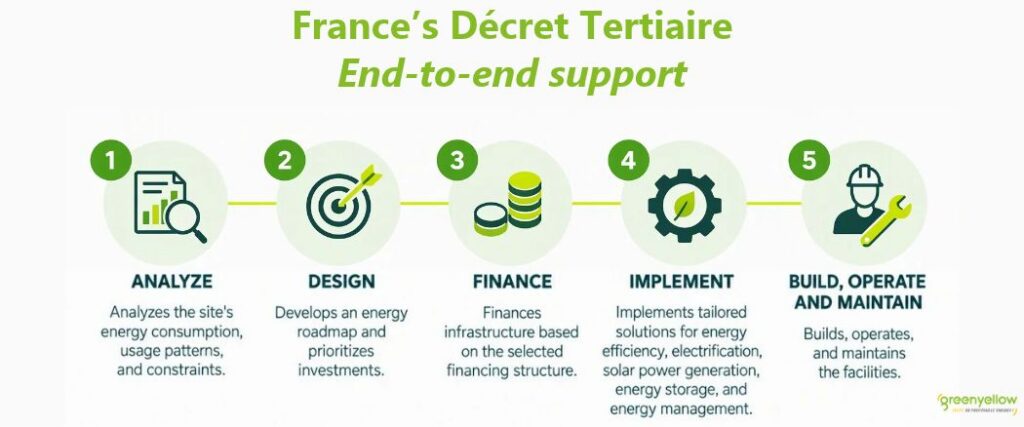
As an industrial orchestrator of flexible electrification, GreenYellow coordinates the solutions best suited to each site, from energy consumption analysis through infrastructure operation. Depending on the project and contractual model selected, GreenYellow:
- Analyzes energy consumption, usage patterns and site constraints.
- Designs an energy roadmap and prioritizes investments.
- Finances infrastructure according to the selected financing structure.
- Deploys tailored energy efficiency, electrification, solar generation, energy storage and energy management solutions.
- Builds, operates and maintains the infrastructure.
This investor-operator approach provides long-term support for projects: GreenYellow does more than recommend equipment. It orchestrates and manages infrastructure development and operation, with contractual performance commitments defined in the agreement.
For retail networks, office portfolios, healthcare facilities, hotels and logistics platforms, energy performance must also be managed across the entire property portfolio.
A consolidated view makes it possible to compare energy consumption, identify priority sites, standardize methodologies and organize progressive deployment programs while tailoring solutions to the specific characteristics of each building.
GreenYellow supports businesses in this process by combining a portfolio-wide approach, local teams and solutions sized for each individual site.
For certain projects, the ESCO model presented by GreenYellow allows businesses to entrust a specialized operator with the design, financing, installation and operation of energy systems, together with performance guarantees.
Frequently asked questions about the Décret Tertiaire
Is the Décret Tertiaire a French regulation?
Yes. The Décret Tertiaire is a French energy efficiency regulation that applies to commercial and service-sector buildings in France that meet the eligibility criteria defined by French law. It establishes progressive final energy consumption reduction targets through 2030, 2040 and 2050 and is implemented through the Éco Énergie Tertiaire (EET) framework and the OPERAT reporting platform.
What is the difference between the Décret Tertiaire and the BACS Decree?
France’s Décret Tertiaire and BACS Decree are two complementary regulations, but they serve different purposes. The Éco Énergie Tertiaire (EET) framework sets final energy consumption reduction targets for commercial and service-sector buildings in France that fall within its scope. The BACS Decree focuses on building automation and control systems, which are used, among other purposes, to monitor and control a building’s technical systems.
Building management systems can therefore contribute to the energy performance trajectory required under the Décret Tertiaire. However, the two regulations have different timelines and scopes and should be assessed separately. French Decree No. 2025-1343 of December 26, 2025 notably postponed certain building automation and control system requirements for existing buildings until 2030. It also amended certain deadlines relating to temperature control and pipe insulation. This postponement does not change the deadlines established under the Éco Énergie Tertiaire framework.
What is the difference between the Décret Tertiaire and the Éco Énergie Tertiaire framework?
The Décret Tertiaire refers to the French regulatory framework established by Decree No. 2019-771 published on July 23, 2019. The Éco Énergie Tertiaire (EET) framework is the operational arm of the Décret Tertiaire, organizing the reduction and monitoring of energy consumption through the OPERAT platform.
Who is responsible for Décret Tertiaire compliance: the owner or the tenant?
Both landlords and tenants are subject to the requirements of France’s Décret Tertiaire, depending on the circumstances. The specific allocation of responsibilities depends on the status of the parties, how the property is operated, the terms of the lease and the applicable French regulations.
The parties must clarify this to ensure the collection of data and transmission of information via OPERAT.
What is the OPERAT platform?
OPERAT is the platform used to collect and monitor energy consumption data under France’s Éco Énergie Tertiaire (EET) framework. It is managed by ADEME, the French Agency for Ecological Transition.
Entities subject to the regulation, including the relevant building owners, landlords and occupants, report their energy consumption through OPERAT. The platform provides, among other features, an annual certificate and an Éco Énergie Tertiaire rating that can be used to monitor progress toward the regulatory targets.
Does the Décret Tertiaire require building upgrades?
No. France’s Décret Tertiaire does not prescribe a standardized list of building upgrades. Instead, it establishes energy consumption reduction targets and provides for several possible areas of action: improving the energy performance of the building and its equipment, installing control and energy management systems, optimizing building operations and adapting usage patterns.
The measures to be implemented therefore depend on the technical, energy and economic characteristics of each building, as well as its required energy reduction trajectory.
Sources :
- Légifrance, Décret n° 2019-771 du 23 juillet 2019 “on requirements for actions to reduce final energy consumption in buildings used for commercial and service-sector activities“
- French Ministry for Ecological Transition – Éco Énergie Tertiaire (EET)
- OPERAT – platform of the Observatory for Energy Performance, Renovation and Actions in the Service Sector

