
SNBC-3 – What are the implications for the energy transition and corporate decarbonization?
On July 15, 2026, France announced the adoption of its third National Low-Carbon Strategy (troisième Stratégie nationale bas-carbone – SNBC-3), a roadmap that sets the country’s trajectory to achieve carbon neutrality by 2050. This new strategy confirms the objective of reducing greenhouse gas emissions by 50% by 2030 compared to 1990, while strengthening national energy sovereignty. It now constitutes the reference framework for French climate policy and guides the actions of public and economic actors.
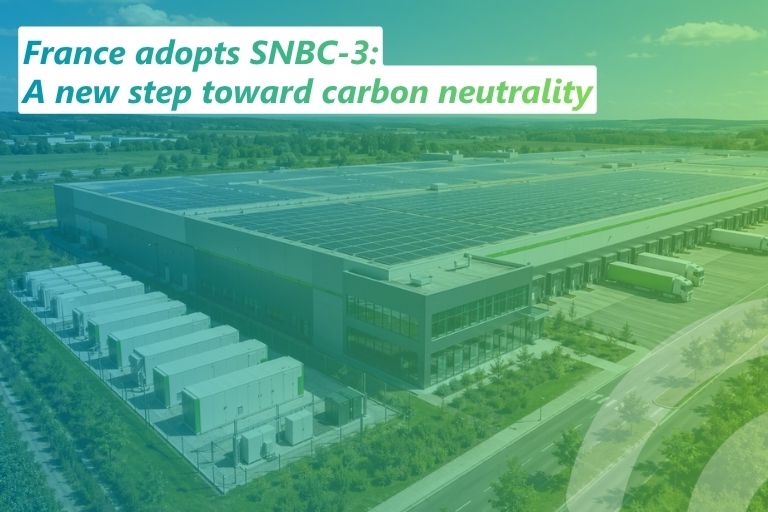
For businesses, SNBC-3 accelerates the transformation of energy models and reinforces the integration of climate issues into development strategies. The reduction of the carbon footprint is based on several key levers: the electrification of uses, the improvement of energy efficiency, the development of renewable energies and the decarbonization of activities. Beyond a regulatory issue, this transition represents an opportunity to reduce consumption, control energy costs and strengthen competitiveness in a low-carbon economy.
What is SNBC-3 – Third National Low-Carbon Strategy?
The National Low-Carbon Strategy is the reference framework for French climate policies. Adopted following a consultation process bringing together local authorities, economic players, associations, experts and citizens, the SNBC-3 defines the trajectories for reducing greenhouse gas emissions for all economic sectors.
It is part of a global vision of ecological planning, alongside the Multi-Year Energy Program (PPE) and the National Plan for Adaptation to Climate Change (PNACC).
One of the main new features of this third edition of SNBC is the integration of a quantified objective for reducing the carbon footprint linked to consumption, including emissions produced abroad to meet the needs of the French.
The objectives of SNBC-3 to reduce greenhouse gas emissions
SNBC-3 provides for a reduction in the national carbon footprint of between 71% and 79% by 2050 compared to 2010. The objective is to reduce the average footprint of a French person to between 2.3 and 3.1 tons of CO₂e per inhabitant.
To achieve this, the strategy is based on several levers: electrification of uses, energy renovation of buildings and industrial transformation.
1/ The electrification of uses
Electrification is identified by the government as the main vector for decarbonizing the French energy system. It is based on the gradual replacement of fossil fuel-powered equipment with electrical solutions powered by largely carbon-free electricity. This lever concerns industrial processes, heating systems, electric vehicle fleets and tertiary equipment.
In the energy sector, the electrification of uses represents an estimated reduction potential of 10 MtCO₂e by 2050.
👉 Download our: ebook: Electrifying to decarbonize – Flexibility to perform
2/ Energy renovation of buildings
The energy renovation of buildings is another major lever for reducing greenhouse gas emissions. Whether it is tertiary or industrial buildings, improving energy performance allows businesses to sustainably reduce their consumption and operating costs. Actions can include insulation, optimization of HVAC systems (heating, ventilation, air conditioning), deployment of LED lighting or the installation of smart energy management solutions.
3/ Industrial transformation
The industrial sectors will also have to continue their efforts through process improvement, energy optimization and the use of carbon-free energies.
Industrial sectors will also have to continue their transformation by improving their processes, optimising their energy consumption and integrating carbon-free energy sources. SNBC-3 promotes the deployment of solutions such as waste heat recovery, intelligent energy management, photovoltaic self-consumption and the optimization of industrial processes in order to sustainably reduce CO₂ emissions while improving operational performance.
What are the impacts of SNBC-3 on businesses?
For businesses, SNBC-3 confirms a fundamental trend: decarbonisation is becoming an economic as well as an environmental imperative.
Organizations must respond to several challenges:
- Reduce their energy consumption,
- Limit their dependence on fossil fuels,
- Meet increasing regulatory requirements,
- Strengthen their competitiveness in a low-carbon economy,
- Reduce their overall carbon footprint.
This dynamic is also creating new opportunities for investment, innovation and sustainable value creation.
Why is the energy transition becoming a lever for competitiveness for businesses?
The low-carbon transition should no longer be seen as a constraint, but as a real lever for competitiveness. By combining energy efficiency, local renewable energy production and electrification of uses, businesses can:
- Reduce their energy costs,
- Secure their supply,
- Control their exposure to energy price volatility,
- Reduce their CO₂ emissions,
- Strengthen their image with customers, investors and partners.
These actions contribute directly to the objectives set by SNBC-3 while creating long-term economic value.
To find out more about the electrification of corporate uses:
👉 Check out our article dedicated to this topic.
How GreenYellow supports businesses in their energy transition to carbon neutrality
Faced with the ambitions of the Third National Low-Carbon Strategy (SNBC-3), businesses need energy partners capable of transforming climate objectives into concrete actions.
GreenYellow supports C&I businesses and the public sector in accelerating their energy transition through a comprehensive and flexible Energy-as-a-Service model. From design to deployment, GreenYellow’s experts develop tailor-made, turnkey projects financed by GreenYellow, allowing clients to benefit from high-performance decarbonization solutions without initial investment, while limiting technical, financial and operational risks.
| Objectives of SNBC-3 | GreenYellow solutions to accelerate the energy transition |
|---|---|
| Reducing greenhouse gas emissions | Decarbonization support: definition of an energy roadmap and implementation of action plans aligned with national and international climate objectives, in an as-a-service model in third-party investment. |
| Improving the energy performance of sites | Energy efficiency: optimisation of equipment, infrastructure and processes to sustainably reduce consumption and energy costs. |
| Accelerating the use of renewable energy | Decentralized solar photovoltaics behind the meter: production of local and competitive renewable electricity to reduce dependence on the grid and fossil fuels. |
| Strengthening the energy resilience of businesses | Energy storage & flexibility: Improving energy flexibility, securing supply and optimising operating costs. |
| Accelerating the electrification of uses | Electrification solutions: adapted to the needs of buildings, industrial sites and infrastructures. |
The adoption of SNBC-3 marks a new stage in the French climate strategy. By placing the electrification of uses, energy efficiency, renewable energies and decarbonization at the heart of its roadmap, France confirms the need to accelerate the transition to a low-carbon economy.
For businesses, this transformation represents much more than a regulatory obligation: it is a lever for competitiveness, control of energy costs and sustainable value creation. By relying on partners who can finance and pilot complex energy projects, they can move faster from climate ambition to concrete action.

